On 26th May 2026, the International Institute of Tropical Agriculture in Ibadan opened its gates to over 200 children and to a question that has never been more urgent: what kind of future are we preparing young Nigerians to inherit, and are we doing enough to equip them for it?
The answer, at least for one day, came in the form of a carefully assembled program that brought together researchers, conservationists, food industry partners, and the children themselves around a single, pressing theme: Raising Young Climate Champions for a Food-Secure Future.
The day began with registration and a guided tour of IITA’s expansive grounds, an environment that quietly makes the case for everything the event stood for. Forests, research plots, and open agricultural land stretched before the children, each a living illustration of what food systems look like when properly tended. By the time breakfast was served, and Kathy Lopez, Head of Communications, and Radio IITA’s Dajie Odok formally welcomed the group, the setting had already begun doing its work.
Sessions throughout the day connected the dots between nature, climate, and the food on Nigerian tables. In the forestry section, experts explained that the health of rainforests is inseparable from national food security, and that a disappearing forest is not just an environmental loss; it is a threat to harvests, water supplies, and livelihoods. Children listened, questioned, and were rewarded for their curiosity.
Nutrition ran as a thread through the entire day. The Nutrition Unit’s live cooking demonstration “showing children how to prepare bean chips from scratch” was one of the afternoon’s most animated moments. Clustered around the demonstration, children watched every step, many making notes, most simply captivated by the idea that a healthy snack could be made rather than just bought.
That theme extended to what the children were served throughout the day. Kellogg’s and Sumal Foods Limited, partners of the event, donated food and snacks that fed the children between sessions. In the context of a day devoted to food security and healthy living, the contribution landed with added weight as familiar brands, present not just as logos but as participants in a conversation about what Nigerians eat, where that food comes from, and who is responsible for making it better.
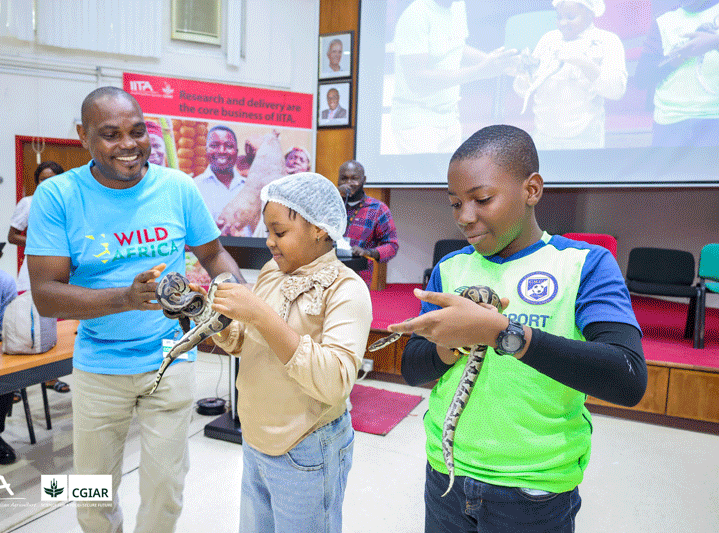
Wild Africa, a partner of Radio IITA, brought the event’s most visceral moment. Dr. Mark Ofua, wildlife veterinarian and Wild Africa representative, introduced the children to two live animals, a rescued ball python and a small hedgehog, both rehabilitated at his wildlife clinic. The room shifted the instant the animals appeared.
Dr. Mark deliberately used that attention, connecting wildlife conservation to climate change, rainforest loss, and food security in terms that children could hold onto. Simple actions like keeping their environments clean, protecting the green spaces around them, understanding that what happens to a forest eventually happens to a farm were framed not as burdens but as the work of champions. A generation is being prepared.
By the time quiz competitions and games filled the final hours, the day had accumulated into something greater than its individual parts. The tour, the sessions, the cooking demonstration, the live animals, the snacks from industry partners, the conversations, each piece reinforced the same idea: that food security and climate resilience are not abstract policy problems. They are daily realities that young people can understand, care about, and act on.
Contributed by Anuoluwapo Oyeleye