For generations, Ikoyi, an ancient town in Isokan Local Government Area of Osun State, has been celebrated across Southwest Nigeria for its deep-rooted traditions, vibrant festivals, and proud warrior heritage. Today, the town is gaining a different kind of recognition, one anchored not in war or royalty, but in environmental conservation and global biodiversity protection.
At the heart of this transformation is the Emerald Forest Reserve (EFR), a 350-acre indigenous forest within Ikoyi that has now been officially designated a Key Biodiversity Area (KBA), one of the most important sites in the world for the survival of rare and endangered species. The recognition places Ikoyi firmly on the global conservation map and crowns more than two decades of quiet, determined effort by the forest’s owners and managers.
The reserve is owned and managed by siblings Prof. Akin Abayomi, Dr. Ekundayo Abayomi, and Dr. Modupe Ladipo under the Abayomi Farm Estate (AFE). Since 2002, the family, born to a Nigerian father and German mother, has worked to protect what remained of an indigenous forest, which was rapidly vanishing due to logging, hunting, and agricultural expansion.
“With limited resources, we decided that doing nothing was not an option,” said Prof. Akin Abayomi, Co-director of the Reserve. “It was a life and death struggle in the early years, but today, hunting and poaching have completely stopped inside the forest.”
Emerald Forest Reserve is dissected by two seasonal streams, the Aworin and Akinrin rivers, which flow into the River Osun. These waterways, bordered by gallery forests, rocky outcrops, and surrounding farmlands, support a wide range of plant and animal species, forming a natural biodiversity corridor.
The forest’s global significance was confirmed through a long-term ornithological monitoring project carried out by the IITA Forest Centre, with support from the Leventis Group. According to Dr. Modupe Ladipo, Co-director of the Reserve, researchers visited the forest every three months over several years to monitor bird populations.
“During the monitoring, they discovered that the Ibadan Malimbe, an endangered and endemic bird species, was not only present but breeding successfully here,” Ladipo explained. “They recorded its calls for the first time ever and documented its nests. That discovery showed the world that this forest is special.”
Once believed to be disappearing due to habitat loss, the Ibadan Malimbe is now known to survive within Emerald Forest Reserve, making it a trigger species for the KBA designation.
“It’s like finding something you thought was gone forever,” Ladipo added. “Seeing this bird again proves that nature can recover if given the chance.”
Key Biodiversity Areas are identified under global standards coordinated by the International Union for Conservation of Nature (IUCN) and are critical for the long-term survival of biodiversity, particularly rare and threatened species.
Beyond the Ibadan Malimbe, Emerald Forest Reserve is home to a wide range of wildlife, including primates such as the Mona monkey (Cercopithecus mona), reptiles like the royal python (Python regius), and threatened tree species such as Afzelia africana, Lophira alata, Nauclea diderrichii, and Pterygota macrocarpa. The reserve is also restoring degraded areas by replacing non-native trees with indigenous species, including Albizia zygia, Ceiba pentandra, and Triplochiton scleroxylon.
A major pillar of the reserve’s success is its community-first conservation model. Former hunters who once depended on the forest for bushmeat are now among its strongest protectors.
Atinude Alade, a former hunter who now serves in the community vigilante group, said, “We used to hunt here to survive. Today, we protect the forest because we understand its value. This forest is our pride.”
To build trust and cooperation, the reserve’s management repaired collapsed bridges damaged by timber trucks and rehabilitated community roads to support farming and local livelihoods, actions that earned long-term goodwill.
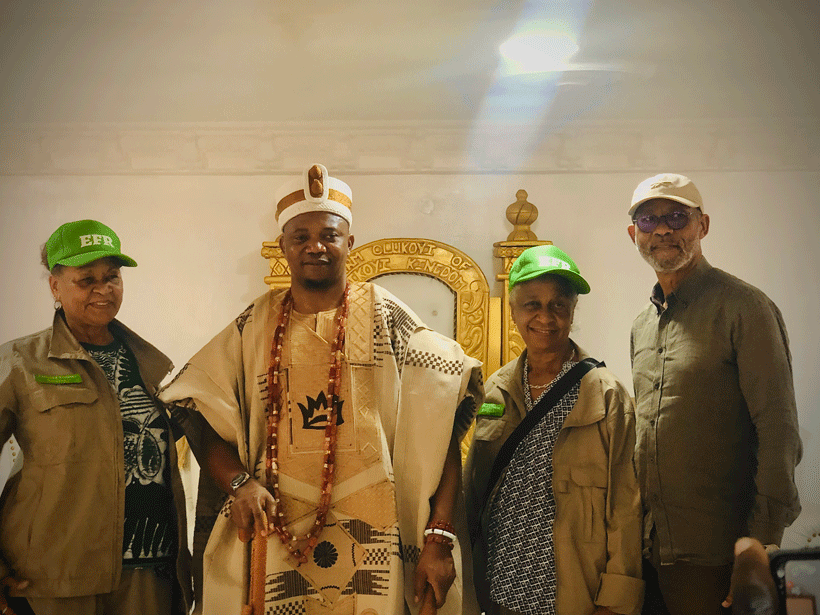
The Olukoyi of Ikoyi Land, Oba Taofeek Akande Iyiola, has pledged the community’s full support for the forest’s protection.
“This forest is a no-go area for logging and trespassing,” the monarch said. “I can assure you that no one in Ikoyi will disobey this law. We want to preserve nature and keep our natural forest alive for future generations.”
He commended the Abayomi family for their commitment, describing them as “true allies of Ikoyi and champions of our land.”
Looking ahead, Emerald Forest Reserve plans to establish a pangolin rescue and rehabilitation center to combat illegal wildlife trade, alongside a seed and genetic bank to preserve Nigeria’s plant and animal DNA for research and ecological restoration.
“We are already certified as a KBA,” Prof. Abayomi said. “The formal ceremony is scheduled for January 2026, when stakeholders, including the Nigerian Conservation Foundation, IITA, and international KBA representatives, will join the community.”
From a threatened forest to a globally recognized biodiversity sanctuary, Emerald Forest Reserve demonstrates what can be achieved when science, community trust, and long-term commitment come together. In Ikoyi, conservation is no longer an abstract concept; it is a living legacy, rooted in local culture and now celebrated on the world stage.
Contributed by Dada Bamise
