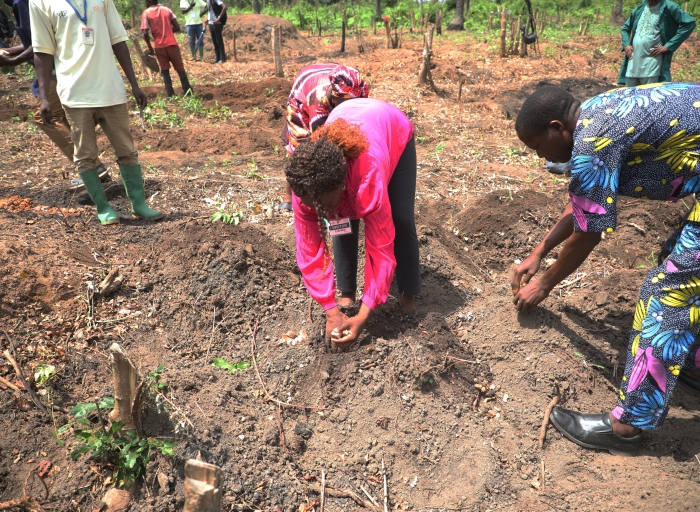
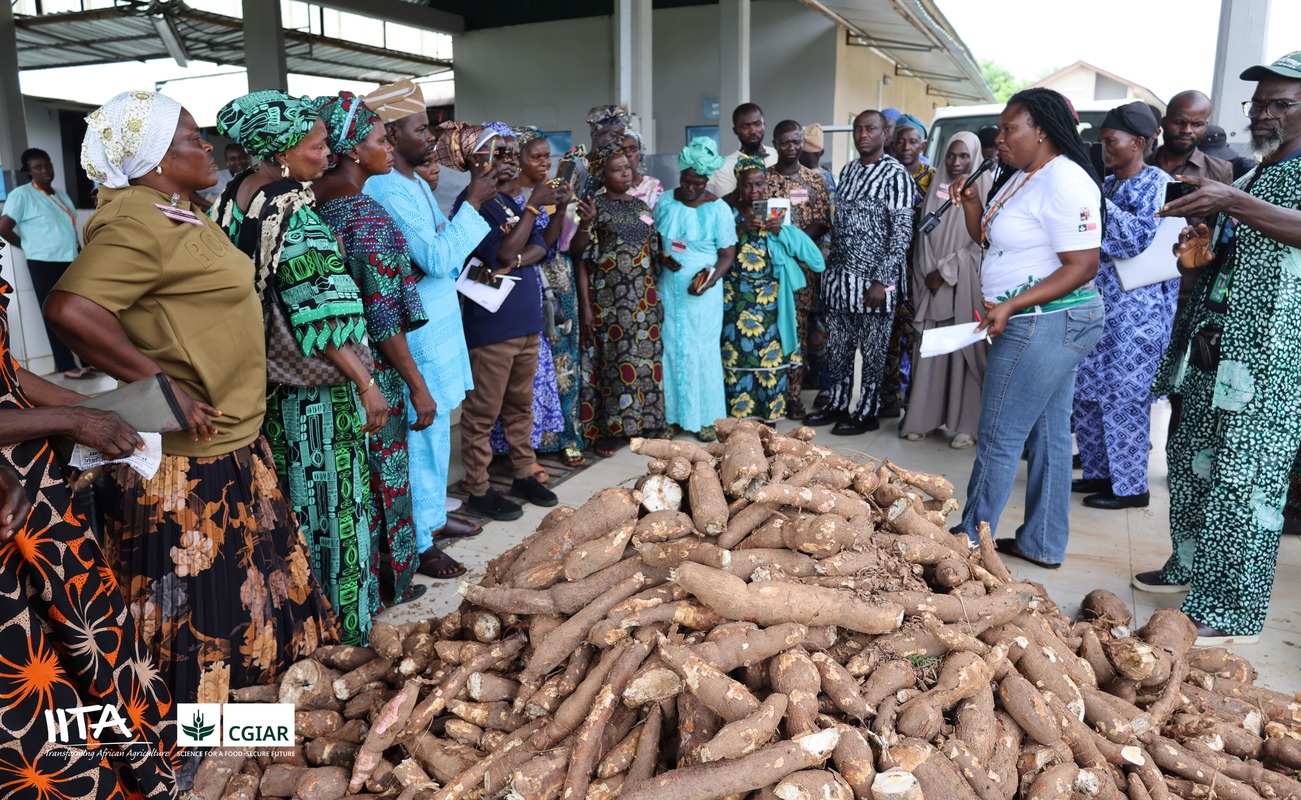
Cassava farmers drawn from several communities in Oyo and Lagos State converged for this year’s edition of the outreach program organized by the breeding program in collaboration with Radio IITA, bringing together beneficiaries of improved cassava stem varieties to share experiences and deepen their knowledge of modern cassava production and processing.
Speaking after the event, the Head of IITA’s Cassava Breeding Unit, Ismail Rabbi, said the interaction made him more aware of the challenges cassava farmers are still facing, describing the conversations as falling broadly into three categories: access to improved planting materials, agronomic practices and inputs, and market access.
First, Rabbi noted that many farmers have seen and recognize the benefits of improved varieties, but simply cannot get enough quality stems to plant. IITA and its partners, he said, are working to build a more commercially sustainable seed system for cassava and other root and tuber crops, combining rapid multiplication technologies with support for local seed entrepreneurs to widen access. Even so, he was candid about the scale of the gap: Nigeria has roughly 10 million hectares suited to cassava cultivation, and current multiplication capacity falls well short of reaching even a tenth of that. Replacing just 10 percent of the cassava currently under cultivation with improved varieties, he said, would already count as meaningful progress.
The second challenge, he explained, is agronomy and inputs. Improved varieties only deliver their full potential when farmers can weed on time and apply fertilizer appropriately, but both require labor and cash that farmers are willing to bear only when the returns justify it.
That, in turn, points to the third and most stubborn bottleneck: commercialization. Rabbi argued that the breeding and agronomic problems are largely solved, with high-yielding, high-starch varieties now available alongside clear guidance on managing them. What remains is building reliable markets and attracting major industry players and investors, without which farmers have little incentive to continue expanding production. He pointed to Vietnam and Thailand as examples of countries that have turned cassava into a genuine industrial crop, converting raw roots into starch and other high-value commodities, and said Nigeria’s government and private sector need to create a similar environment.
Farmers who attended described tangible gains from the varieties already in their fields. Michael Oladele said the improvements he has seen in cassava stems distributed by IITA, including Baba 70, Digi, and Game Changer, were what drew him to the outreach to learn more about them. Jide Morounkeji, who had grown the popular 419 variety for years, said the program introduced her to improved varieties and better practices she now intends to adopt, and broadened her sense of cassava’s economic potential beyond the familiar staples to products such as cakes, moi moi, chips, tapioca, and cookies.
Mr. Abdullahi of the Cassava Farmers Association in Iwo, who had relied on the 419 variety before IITA introduced his association to Baba 70, Renewed Hope, and Bigi, said comparing the varieties helped him appreciate their distinct strengths.
Contributed by Anuoluwa Oyeleye