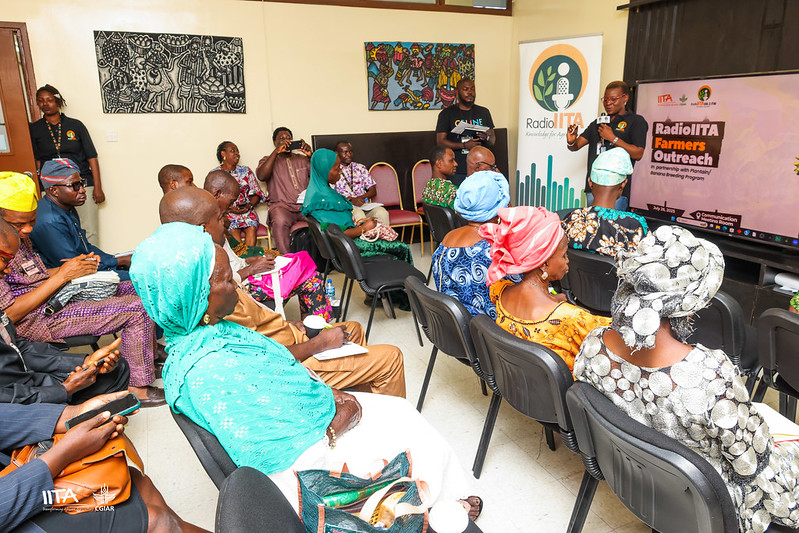
To strengthen banana and plantain production in Nigeria and beyond, Radio IITA, in collaboration with the plantain and banana breeding program of the International Institute of Tropical Agriculture (IITA organized an intensive outreach program for over 30 smallholder farmers. The training, held on July 25, 2025, is part of the broader Radio IITA Farmers Outreach Initiative, which connects farmers with cutting-edge agricultural innovations developed by IITA.
In her opening remarks, IITA Plantain Breeder and Program Lead, Delphine Amah, emphasized that farmers remain at the heart of food security efforts. “Every innovation we develop is centered around farmers. This outreach is about listening to you and shaping our research based on your realities,” she said.
Radio IITA Lead, Dajie Odok, encouraged farmers to maximize the opportunity by engaging directly with scientists. “Use this space to ask questions, share your challenges, and apply the knowledge you gain here,” she urged, stressing that innovations thrive best when embraced at the grassroots.
Delivering a goodwill message, Dr. Olubunmi Ibitoye, Research Director of the National Horticultural Research Institute (NIHORT), commended the collaboration between IITA and NIHORT. He announced that both institutions are working to release a clean and known cultivar that will eliminate diseases from farmers’ fields and increase their incomes.
IITA Plantain Breeder Dr. Moses Nyine underscored the importance of bananas and plantain as vital food and income sources for millions of Nigerians. However, he noted that pests, diseases, poor-quality planting materials, and climate change continue to threaten productivity. He stressed that sustainable production begins with clean planting materials, one of the key focuses of the training.
Participants were introduced to the macro propagation technique, a cost-effective, farm-level method for producing clean, disease-free suckers. This technique enables farmers to multiply virus-free and uniform plantlets, improving both plant health and yields.
The training also covered field sanitation, pest and disease management, proper plant spacing, and the adoption of improved plantain varieties. Farmers actively engaged throughout the session, asking questions and showing strong interest in adopting the techniques learned.
A highlight of the event was the handover of 60 tissue-culture plantlets to the farmers. Developed through macro propagation, these plantlets will serve as a foundation for farmers to replicate and multiply on their farms, ensuring a sustainable supply of high-quality suckers in their communities.
To encourage continuous learning, Radio IITA invited participants to join a dedicated WhatsApp group, where they can share experiences, ask questions, and receive regular updates on relevant research.
As agriculture continues to play a central role in food security and livelihoods, initiatives like this ensure that smallholder farmers remain equipped, connected, and resilient in the face of climate change.
Contributed by Anu Oyeleye